1998 · Blowup · Bubbles, Black Swans and Crisis Alpha
Long-Term Capital Management
Two Nobel laureates, $100 billion in borrowed money, and five weeks to lose it.
- Started
- Feb 1994
- Capital, Jan 1998
- $4.7 bn
- Lost in August
- 44%
- Rescue
- Sep 23, 1998
What happened
John Meriwether had run the bond-arbitrage desk at Salomon Brothers. In 1994 he started his own fund, Long-Term Capital Management, in Greenwich, Connecticut. His partners included Myron Scholes and Robert Merton, the economists behind modern option pricing. The fund raised $1.25 billion, the largest start-up of its time.
The strategy bet that small price gaps between related bonds would close. Each gap paid little, so the fund borrowed to make it pay. By the end of 1995 it held $102 billion in assets on $3.6 billion of capital: 28 to 1. Its derivatives book reached $1.25 trillion in face value.
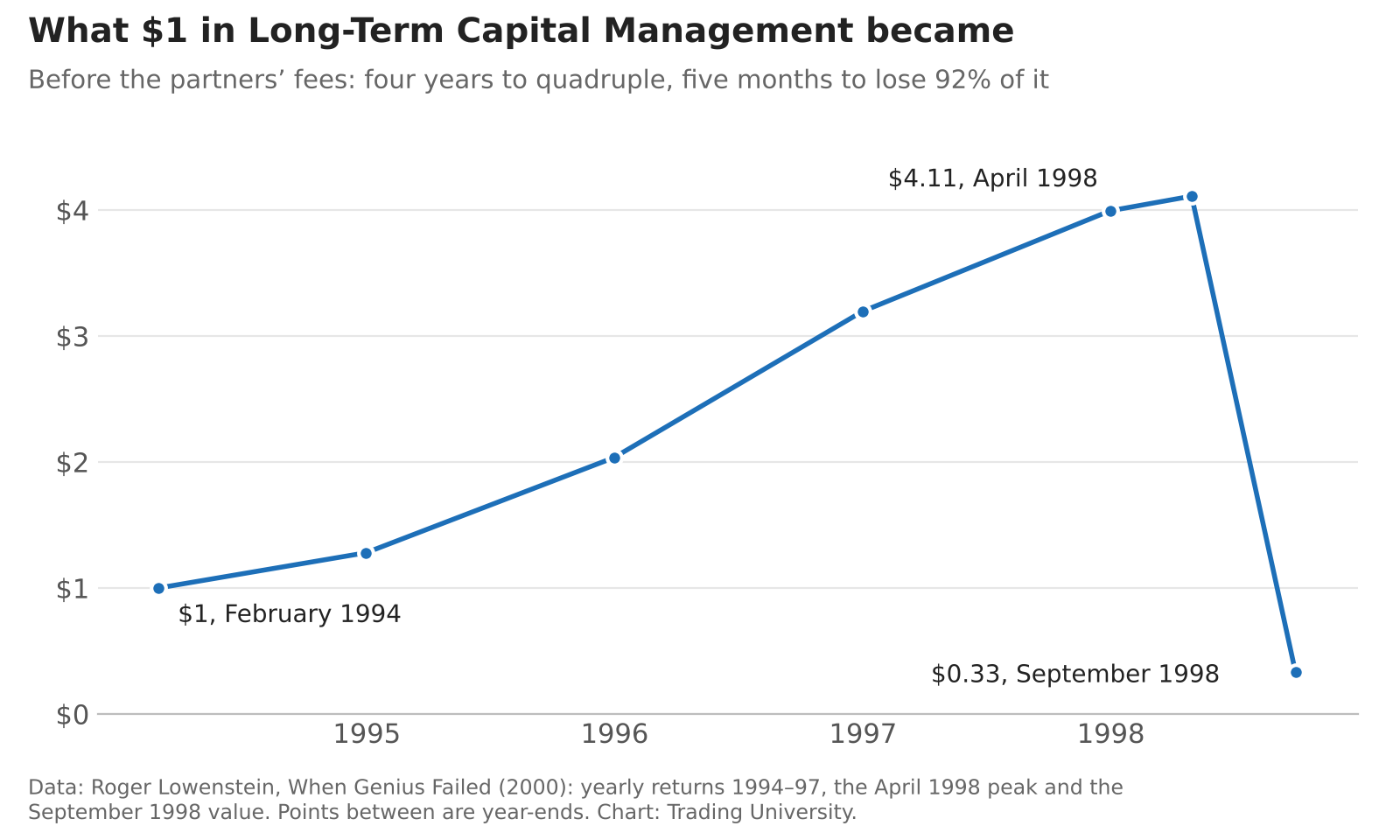
For four years it worked. Before fees, a dollar invested in 1994 grew to $4.11 by April 1998. In 1997 the Nobel committee honored Scholes and Merton.
On August 17, 1998, Russia stopped paying its debts. Investors everywhere ran for the safest bonds, and the gaps the fund had bet on grew wider. In August the fund lost $1.9 billion, 44 percent of its capital. In September the losses kept coming, and the banks that had lent to it faced the prospect of its positions being dumped on the market.
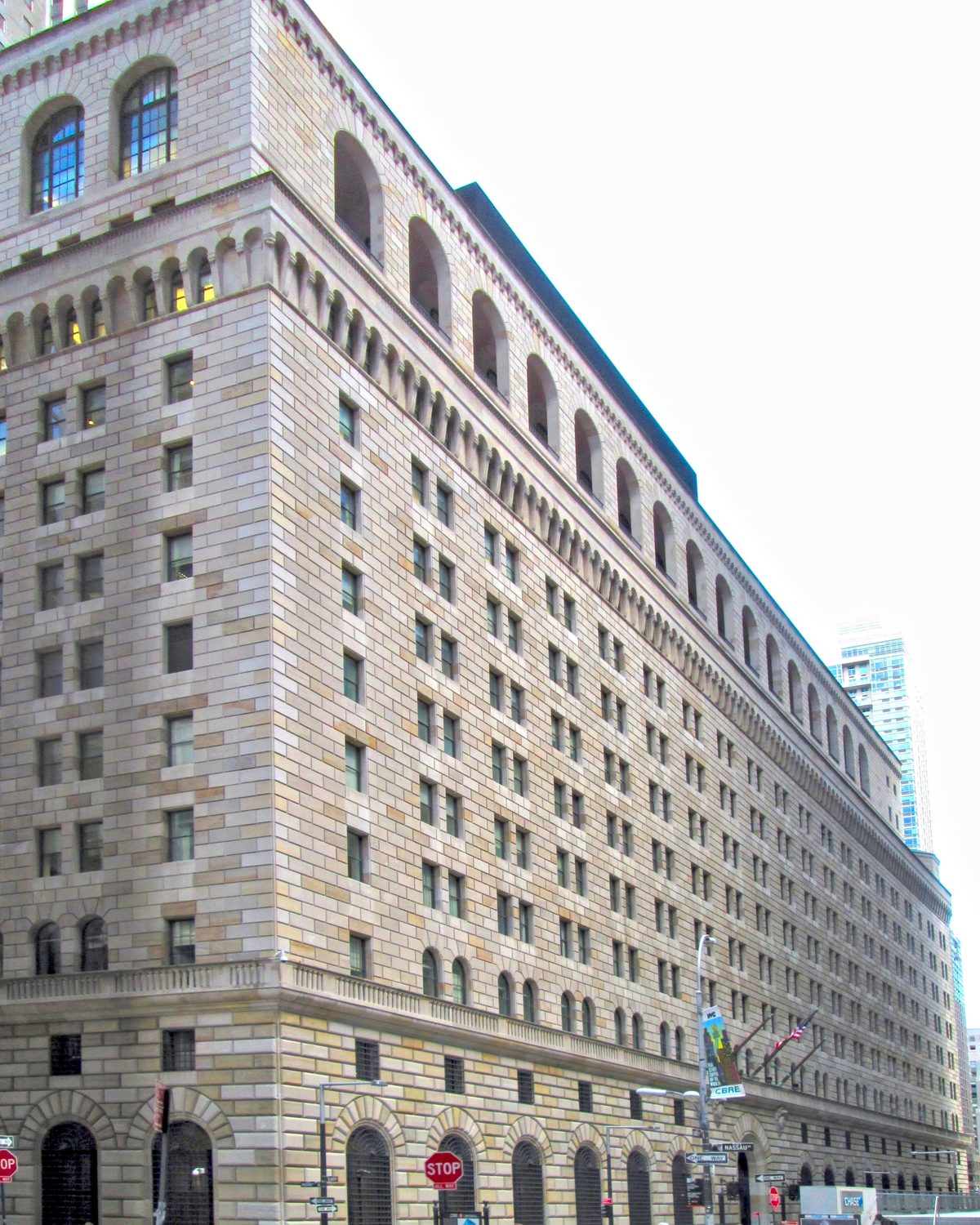
On September 23, William McDonough, president of the Federal Reserve Bank of New York, brought the heads of Wall Street's largest banks to the Fed's boardroom. Fourteen banks put in $3.65 billion and took 90 percent of the fund. No public money was spent. The Fed then cut interest rates three times that autumn.
The fund's investors and partners lost about $4.5 billion. Fifteen months after the rescue, Meriwether raised $250 million for a new fund.
Who lost, who won
August and September 1998 were a zero-sum transfer. The fund's losses, and the losses of those caught in the same trades, were gains for traders positioned for the move.
Lost
| Long-Term Capital ManagementAugust 1998 alone | $1.9 bn |
| Tiger Fund (Julian Robertson)Aug–Sep 1998 | $3.3 bn |
| Quantum Fund (George Soros) | $2.0 bn |
| Everest Capital | $1.3 bn |
| UBS | $690 m |
| Dresdner | $145 m |
| Bank of Italy | $100 m |
Won
| Dunn Capital, WMAAug / Sep 1998 | +27.5% / +16.8% |
| John W. Henry, Financials & Metals | +17.5% / +15.3% |
| Man Investments | +14.5% / +3.6% |
| Dunn Capital, TOPS | +9.5% / +12.9% |
| Campbell & Company | +9.2% / +3.0% |
| Chesapeake Capital | +7.3% / −0.6% |
Losses as reported by CNN; monthly returns from Michael Covel, Trend Following, Table 4.4. Dunn, Henry, Campbell, Chesapeake and Man together made more than $1 billion in August and September 1998.
Performance figures are as published by the firms named, whose records are on file with the CFTC. Past performance is not necessarily indicative of future results. Trading University is not an agent for any firm named and makes no offer to invest.
In their own words
“Losses of this magnitude are a shock to us as they surely are to you.”
John Meriwether, letter to investors, September 1998
“All the relations that tended to exist in a recent past seemed to disappear.”
Myron Scholes, on August 1998, quoted in Covel, Trend Following
“Managed futures were king and on the front page of The Wall Street Journal.”
Campbell & Company, on autumn 1998, quoted in Covel, Trend Following
People
- John Meriwether · founder
- Myron Scholes · partner
- Robert C. Merton · partner
- William J. McDonough · New York Fed
- Alan Greenspan · Federal Reserve
- Bill Dunn · Dunn Capital
- John W. Henry
- Jerry Parker · Chesapeake
- Keith Campbell
Ideas
- Zero-sum transfer
- Fat tails
- Picking up nickels in front of a steamroller
- Leverage
- Bailouts and moral hazard
- Models vs. reality
- Survivorship and silent evidence
- Survival first
- Simple rules beat complex models
- Loss aversion and overconfidence
- Bet sizing (Kelly)
- Overfitting
- Measuring risk
- The seen and the unseen
The record
Roger Lowenstein, 2000
Michael Covel
- Also in The (Mis)Behavior of Markets (Benoit Mandelbrot & Richard Hudson); The Black Swan (2nd ed.) (Nassim Taleb); The Pit & the Pendulum: A Menagerie of Speculative Follies (David Harding and James Holmes); The Big Short (Michael Lewis); The Battle for Investment Survival (1965 ed.) (Gerald Loeb); The Harriman House Book of Investing Rules; Hedge Fund Market Wizards (Jack Schwager); A Man for All Markets (Edward Thorp); The Man Who Solved the Market (Gregory Zuckerman); The Complete TurtleTrader (Michael Covel); Adaptive Markets (Andrew Lo); Efficiently Inefficient (Lasse Heje Pedersen); Fortune’s Formula (William Poundstone); Antifragile (Nassim Taleb); More Money Than God (Sebastian Mallaby); Fooled by Randomness (Nassim Taleb); Too Big to Fail (Andrew Ross Sorkin); Misbehaving (Richard Thaler); Trend Following Mindset (Tom Basso) (Michael Covel); Why Stock Markets Crash (Didier Sornette); The Invisible Hands: Top Hedge Fund Traders on Bubbles, Crashes, and Real Money (rev. ed.) (Steven Drobny); Speculation, Trading, and Bubbles (José A. Scheinkman, with Kenneth Arrow, Patrick Bolton, Sanford Grossman and Joseph Stiglitz); Booms and Busts: An Encyclopedia of Economic History from Tulipmania of the 1630s to the Global Financial Crisis of the 21st Century (James Ciment (editor)); Largest Quarterly S&P Losses Since 1980 (Sunrise Capital Partners); Manias, Panics, and Crashes: A History of Financial Crises (Robert Z. Aliber, Charles P. Kindleberger and Robert N. McCauley)
- Official Alan Greenspan, testimony to the House Banking Committee on the LTCM rescue, October 1, 1998
- Official US General Accounting Office, Long-Term Capital Management: Regulators Need to Focus Greater Attention on Systemic Risk, 1999