1907 · Panic · Bubbles, Black Swans and Crisis Alpha
Panic of 1907
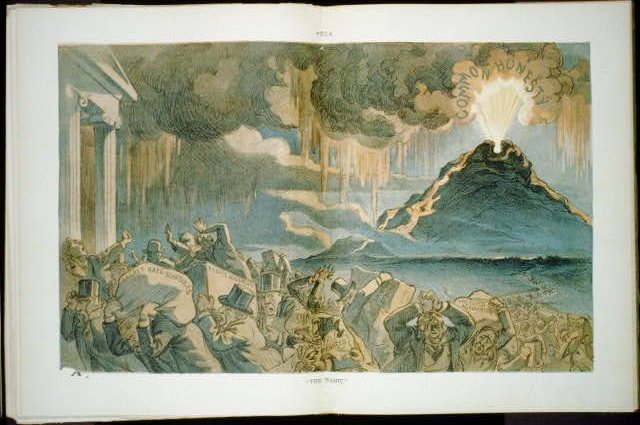
A failed attempt to corner a copper stock set off runs on New York's trust companies. J. P. Morgan organized the rescue, and the panic led to the Federal Reserve.
- Copper corner fails
- Oct 16, 1907
- Knickerbocker Trust closes
- Oct 22, 1907
- Call money
- up to 100%
- Dow, Jan 1906 to Nov 1907
- about −49%
What happened
In October 1907 F. Augustus Heinze and his brother Otto tried to corner the shares of United Copper. The attempt failed on October 16, and the stock collapsed. Depositors ran on banks linked to Heinze and then on the Knickerbocker Trust, whose president was his associate. Knickerbocker closed on October 22.
The runs spread to other trust companies, which faced lighter regulation and held small reserves. On October 24 money to lend against stocks came close to running out on the New York Stock Exchange, and call loan rates reached 100%.
J. P. Morgan, aged 70, gathered bankers in his library, decided which firms to save and raised pools of money to lend. The Treasury deposited funds in New York banks. In November Morgan arranged for US Steel to buy the Tennessee Coal, Iron and Railroad Company to rescue a brokerage that held its shares.
Jesse Livermore had been short and covered on the worst day. He told Edwin Lefèvre his winnings that day passed $1 million. Congress set up a commission to study the panic, and its work led to the Federal Reserve Act of 1913.
In their own words
“That was the day I remember most vividly of all the days of my life as a stock operator. It was the day when my winnings exceeded one million dollars.”
Edwin Lefèvre, Reminiscences of a Stock Operator (1923)
People
Ideas
The record
Robert Bruner & Sean Carr
Edwin Lefèvre
- Also in Fifty Years in Wall Street (Henry Clews); Trend Following (Michael Covel); Lords of Finance (Liaquat Ahamed); The Stock Market Barometer (William Peter Hamilton); Booms and Busts: An Encyclopedia of Economic History from Tulipmania of the 1630s to the Global Financial Crisis of the 21st Century (James Ciment (editor)); The Intelligent Investor (Benjamin Graham, with commentary by Jason Zweig); How I Trade and Invest in Stocks and Bonds (Richard D. Wyckoff); How to Trade in Stocks (Jesse L. Livermore); Manias, Panics, and Crashes: A History of Financial Crises (Robert Z. Aliber, Charles P. Kindleberger and Robert N. McCauley)
- Free text Edwin Lefèvre, Reminiscences of a Stock Operator (1923), full text at Project Gutenberg