1929 · Crash · Bubbles, Black Swans and Crisis Alpha
Crash of 1929
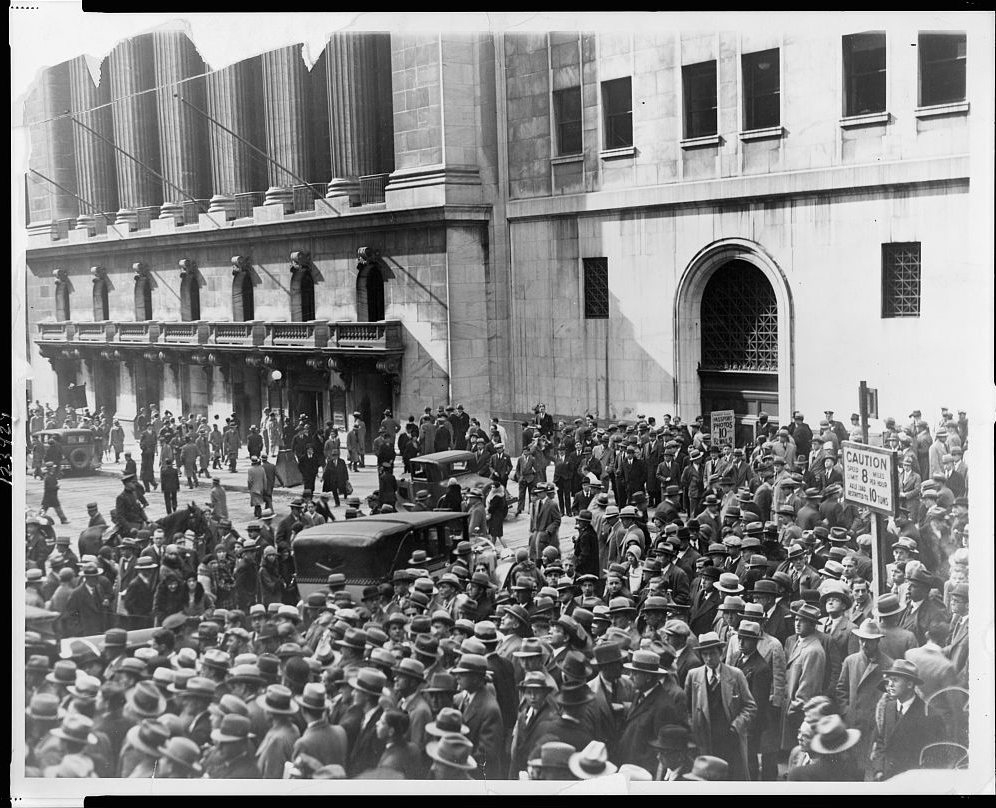
After a decade-long boom, the Dow fell 23% in two days in late October 1929. Some traders who had sold short made fortunes.
- Dow peak
- 381, Sep 3, 1929
- Black Thursday
- Oct 24, 1929
- Oct 28–29
- −23% in two days
- Low that autumn
- 199, Nov 13
What happened
The Dow Jones Industrial Average rose about sixfold from 1921 to its peak of 381 on September 3, 1929. Investors bought on margin, putting down as little as 10%, and loans to buy stock grew to record levels.
On October 15 the Yale economist Irving Fisher said stock prices had reached what looked like “a permanently high plateau.” Prices had been slipping since September. On Thursday, October 24 selling overwhelmed the market. A group of bankers pooled money, and Richard Whitney, vice president of the exchange, walked onto the floor and bid above the market for US Steel. Prices steadied.
On Monday, October 28 the Dow fell 12.8%, and on Tuesday it fell another 11.7%. Margin calls forced more selling. By November 13 the Dow was at 199, down 48% from its peak.
Jesse Livermore was short through the fall and was reported in the press to have made about $100 million. Richard Whitney, the hero of Black Thursday, was convicted of embezzlement in 1938 and went to Sing Sing.
In their own words
“Stock prices have reached what looks like a permanently high plateau.”
Irving Fisher, October 15, 1929
People
Ideas
- Leverage
- The new era
- Callers vs. followers
- Credit-made booms
- Stability breeds instability
- Mr. Market
The record
- Reading The Battle for Investment Survival (1965 ed.) (Gerald Loeb); Against the Gods (Peter Bernstein); The (Mis)Behavior of Markets (Benoit Mandelbrot & Richard Hudson); The Harriman House Book of Investing Rules; When Genius Failed (Roger Lowenstein); The Black Swan (2nd ed.) (Nassim Taleb); The Language of Money (Annabelle Mooney); Trend Following (Michael Covel); The Pit & the Pendulum: A Menagerie of Speculative Follies (David Harding and James Holmes); A Man for All Markets (Edward Thorp); Market Wizards (Jack Schwager); The Alchemy of Finance (George Soros); Lords of Finance (Liaquat Ahamed); The Price of Time (Edward Chancellor); Irrational Exuberance (3rd ed.) (Robert Shiller); Stabilizing an Unstable Economy (Hyman Minsky); Triumph of the Optimists (Elroy Dimson, Paul Marsh and Mike Staunton); Why Stock Markets Crash (Didier Sornette); Bubbles and Crashes: The Boom and Bust of Technological Innovation (Brent Goldfarb and David A. Kirsch); Bubbles, Crashes and Financial Disasters (Ralph Lyons); Speculation, Trading, and Bubbles (José A. Scheinkman, with Kenneth Arrow, Patrick Bolton, Sanford Grossman and Joseph Stiglitz); The Invisible Hands: Top Hedge Fund Traders on Bubbles, Crashes, and Real Money (rev. ed.) (Steven Drobny); Booms and Depressions: Some First Principles (Irving Fisher); Booms and Busts: An Encyclopedia of Economic History from Tulipmania of the 1630s to the Global Financial Crisis of the 21st Century (James Ciment (editor)); The Psychology of Money: Timeless Lessons on Wealth, Greed, and Happiness (Morgan Housel); The Intelligent Investor (Benjamin Graham, with commentary by Jason Zweig); Tape Reading and Market Tactics: The Three Steps to Successful Stock Trading (Humphrey B. Neill); How to Trade in Stocks (Jesse L. Livermore); S&P 500 Corrections & Bear Markets Since 1928 (Yardeni Research); Manias, Panics, and Crashes: A History of Financial Crises (Robert Z. Aliber, Charles P. Kindleberger and Robert N. McCauley)