2007–2009 · Crash · Bubbles, Black Swans and Crisis Alpha
Financial crisis
American house prices fell, mortgage securities failed and the banking system came close to stopping. US stocks fell 57%. Trend followers had one of their best years.
- S&P 500 peak
- Oct 9, 2007
- S&P 500 low
- Mar 9, 2009
- Fall
- −57%
- Worst month
- October 2008
What happened
Through the early 2000s lenders made home loans to borrowers with weak credit, often with low starting rates that reset higher after two or three years. Banks bundled the loans into securities, rated many of them AAA, and sold them around the world. House prices peaked in 2006 and then fell.
A few investors bet against the securities with credit default swaps. Michael Burry of Scion Capital, Steve Eisman at FrontPoint Partners and John Paulson made fortunes; Paulson's funds gained about $15 billion in 2007.
Losses spread through 2007 and 2008 to the banks that held the securities and the insurers that guaranteed them. After Lehman Brothers failed in September 2008, lending froze. The S&P 500 fell 17% in October 2008 alone and reached its low on March 9, 2009, down 57% from October 2007. Berkshire Hathaway's stock fell 51% over 2007–2009.
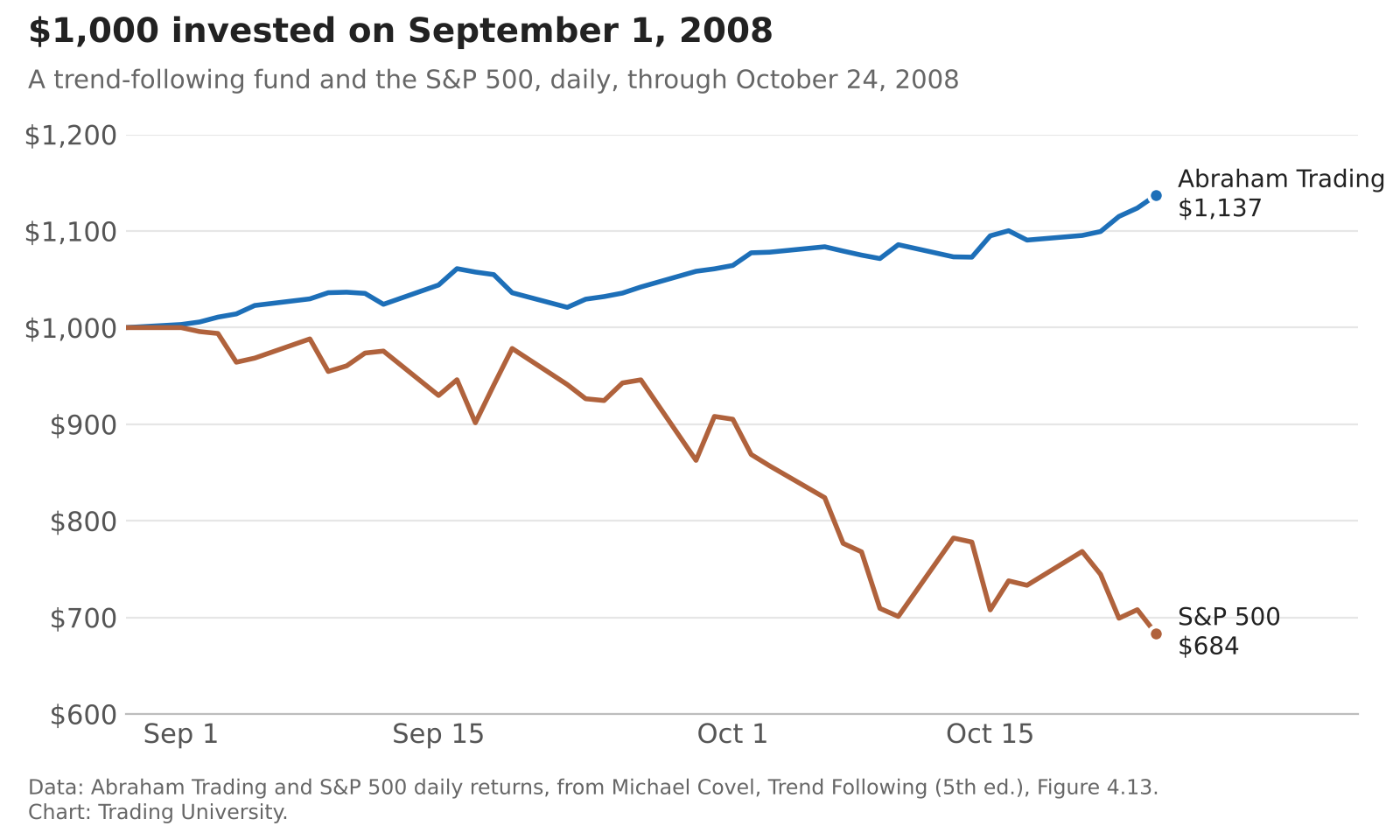
Trend followers did not predict the crash. They were short stock indexes and long bonds because those trends were already under way, and they also made money in currencies, energy and grains as prices swung.
Who lost, who won
The same months, two sides.
Lost
| S&P 500Oct 2007 to Mar 2009 | −57% |
| Berkshire Hathaway2007–2009 | −51% |
Won
| Mulvaney CapitalOctober 2008 | +45.5% |
| Mulvaney Capital2008 | +108.9% |
| Clarke CapitalJan–Oct 2008 | +82.2% |
| John W. Henry & CompanyJan–Oct 2008 | +72.4% |
| TranstrendJan–Nov 2008 | +71.8% |
| Drury CapitalJan–Oct 2008 | +56.9% |
Returns as published by the firms named, from Michael Covel, Trend Following, Chapter 4, and Mulvaney Capital's factsheet.
Performance figures are as published by the firms named, whose records are on file with the CFTC. Past performance is not necessarily indicative of future results. Trading University is not an agent for any firm named and makes no offer to invest.
People
- Michael Burry · Scion Capital
- Steve Eisman · FrontPoint Partners
- John Paulson · Paulson & Co.
- Bernard Drury · Drury Capital
- Paul Mulvaney · Mulvaney Capital
- John W. Henry
- Ben Bernanke · Federal Reserve
Ideas
- Zero-sum transfer
- Black Swan
- Fat tails
- Random walk vs. trends
- Easy credit
- Models vs. reality
- Survivorship and silent evidence
- Expected and unexpected drawdowns
- Narrative fallacy
- Callers vs. followers
- Cut losses, let winners run
- Calendar trap
- Simple rules beat complex models
- Credit-made booms
- Antifragility
- Frequency vs. magnitude
- Stability breeds instability
- Mr. Market
The record
Michael Lewis
Michael Covel
Gregory Zuckerman
- Also in The Language of Money (Annabelle Mooney); When Genius Failed (Roger Lowenstein); The Black Swan (2nd ed.) (Nassim Taleb); The Harriman House Book of Investing Rules; The Pit & the Pendulum: A Menagerie of Speculative Follies (David Harding and James Holmes); Hedge Fund Market Wizards (Jack Schwager); The Man Who Solved the Market (Gregory Zuckerman); Adaptive Markets (Andrew Lo); Efficiently Inefficient (Lasse Heje Pedersen); Antifragile (Nassim Taleb); More Money Than God (Sebastian Mallaby); The Price of Time (Edward Chancellor); Too Big to Fail (Andrew Ross Sorkin); Irrational Exuberance (3rd ed.) (Robert Shiller); The Invisible Hands: Top Hedge Fund Traders on Bubbles, Crashes, and Real Money (rev. ed.) (Steven Drobny); Bubbles, Crashes and Financial Disasters (Ralph Lyons); Speculation, Trading, and Bubbles (José A. Scheinkman, with Kenneth Arrow, Patrick Bolton, Sanford Grossman and Joseph Stiglitz); Bubbles and Crashes: The Boom and Bust of Technological Innovation (Brent Goldfarb and David A. Kirsch); “Learning to Love Investment Bubbles: What if Sir Isaac Newton Had Been a Trendfollower?” (Mebane Faber); Mr. Market Miscalculates: The Bubble Years and Beyond (James Grant); Booms and Busts: An Encyclopedia of Economic History from Tulipmania of the 1630s to the Global Financial Crisis of the 21st Century (James Ciment (editor)); The Origin of Financial Crises: Central Banks, Credit Bubbles and the Efficient Market Fallacy (George Cooper); Largest Quarterly S&P Losses Since 1980 (Sunrise Capital Partners); Manias, Panics, and Crashes: A History of Financial Crises (Robert Z. Aliber, Charles P. Kindleberger and Robert N. McCauley)